
Share this
by Hal Koss
Key Takeaways
- Freight execution loses margin when every step depends on manual follow-up.
- Shipping automation connects rates, tenders, tracking, and charges in one flow.
- Automated booking clears rejected tenders and routine invoices automatically.
- ROI shows up as lower labor, faster cycles, and tighter cost control.
Freight execution can lose margin for many reasons, including delayed tenders, missed appointment updates, duplicate reference numbers, unreviewed charges, and disconnected shipment records. A routine load can become a cost issue when each execution step depends on manual follow-up.
Shipping automation has become a practical way to reduce that execution friction. By connecting shipment data, carrier actions, rates, documents, milestones, and charges in one workflow, it helps transportation teams make faster decisions, reduce manual intervention, and gain stronger control over execution costs.
What Is Shipping Automation’s Role in Freight Execution?
Shipping automation keeps freight moving as conditions change by surfacing the actions that need attention instead of leaving them to manual shipment checks. The system can flag work across rating, tendering, appointments, tracking, documents, and settlement so nothing waits on a person to notice it first.
A load may start with an expected carrier, rate, pickup date, and delivery plan, then shift because of a rejected tender, moved appointment, expired rate, missing document, or added charge. When those updates stay connected to the shipment, teams can understand what changed and act without rebuilding the full context.
That connected workflow also makes repeatable decisions easier to manage. Rates, tender rules, carrier follow-ups, document requests, and invoice thresholds reduce the manual coordination required to keep each shipment moving.
How Does Automated Freight Booking Reduce Manual Booking Bottlenecks?
Automated freight booking reduces bottlenecks by removing the repeated checks that stall a load between steps. Manual freight work builds up when teams verify the same details across every shipment: carrier responses, rate options, tender status, appointments, tracking updates, documents, charges, and invoices.
At scale, those checks slow the team’s response to work that needs judgment, such as service risks, carrier issues, cost disputes, and exception management.
Purpose-built freight execution software reduces that drag by turning repeatable actions into system-supported workflows. Automated tendering can move to the next carrier when the first option rejects or times out. Book-now functionality can turn an approved target rate into an instant booking. Auto-approval logic can clear invoices within defined variance thresholds.
The team still controls the freight operation, while predictable follow-up moves through a more automated workflow.
How Does Automation Improve Shipping Cost Control?
Automation improves cost control by keeping cost decisions tied to live execution. Control starts with carrier selection and rate visibility, then continues through tender outcomes, appointment changes, delivery events, added charges, and freight audit and payment review.
Negotiated rates and carrier agreements only create savings when execution follows the plan. If a contracted carrier rejects a tender, a spot rate expires, or a carrier adds a charge after delivery, teams need enough context to protect cost without slowing the load. Real-time freight visibility across delivery events keeps those changes attached to the shipment as they happen.
This reduces the gap between the booked rate and the final paid cost by keeping planned pricing, operational changes, and final charges tied to the same shipment record.
What ROI Can Shippers Expect From Automating Freight Execution?
Shippers can expect freight execution ROI to become clearer in four areas:
- Lower manual workload: Teams spend less time sending follow-ups, checking shipment status, chasing documents such as the bill of lading, and reconciling spreadsheets. Operations can manage more volume without tying every increase to more headcount.
- Faster execution cycles: Carrier selection, tendering, appointment coordination, tracking follow-up, and invoice review move with less waiting time between steps. Fewer pauses reduce delays caused by missing information, unclear ownership, or late action.
- Stronger cost control: Rate visibility, tender logic, charge review, and invoice thresholds help teams catch cost issues earlier. Planned pricing, added charges, and invoice review stay connected to the same shipment record. When milestones, charges, and carrier actions all live in one workflow, fewer details are lost.
- More reliable performance: Connected shipment events, documents, costs, and carrier actions make recurring issues easier to identify. Managers can see which lanes, facilities, carriers, or workflow steps create repeated delays, disputes, or cost leakage. That visibility also makes daily management, training, and network-level oversight easier to maintain.
Agentic Execution: Moving from Rules to Intent-Driven Automation
Rule-based automation handles predictable follow-up well, but it still waits for a person to decide what to do when a shipment falls outside the rules. Agentic execution moves past that limit. Instead of configuring an IF/THEN trigger for every scenario, a team describes the outcome it wants and lets the system carry it out across the shipments that match.
With agents built at the platform level, a dispatcher can act on hundreds of active shipments at once using an intent-driven prompt rather than clicking through each load. Asking to re-tender every load a carrier just rejected on a lane, request updated appointments for a facility, or flag shipments missing a POD runs as a single guided task.
This is the shift built into an AI-native TMS: execution moves from static rules toward goal-oriented automation, where the system interprets what a team is trying to accomplish and keeps shipments moving within the guardrails the team sets. Planners still own strategy and exceptions, while routine judgment scales across the network.
See Real Freight Execution ROI With ShipperGuide
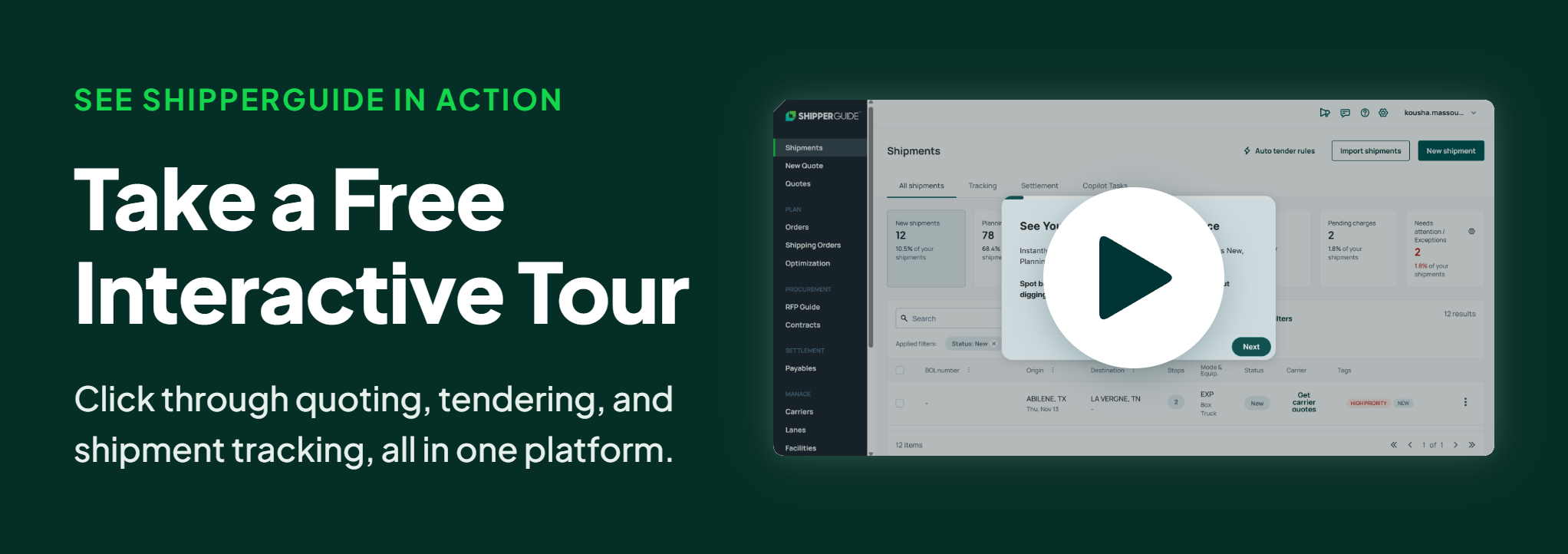
Manual follow-up makes freight ROI harder to measure because cost, service, and execution data get scattered across the shipment lifecycle. ShipperGuide connects rates, tenders, appointments, tracking, documents, charges, and invoices in one workflow, giving teams a clearer view of where automation improves speed, control, and cost performance.
See how ShipperGuide turns shipping automation into measurable execution ROI.

Frequently Asked Questions
What Is Shipping Automation and How Does It Improve Freight Execution?
Shipping automation uses rules and connected shipment data to reduce manual coordination across rating, tendering, appointments, tracking, documents, charges, and invoices. When a tender is pending, an appointment changes, or a charge needs review, teams can see the shipment context, the next action, and the cost or service risk attached.
How Do You Measure the ROI of Freight Management Software?
Measure ROI against a clear execution baseline, comparing pre- and post-implementation performance across key metrics: time to book, tender acceptance rate, manual touches per shipment, rate variance, post-booking charges, on-time pickup and delivery performance, missing PODs, invoice cycle times, disputes, and cost per shipment. Faster booking reflects execution speed. Fewer manual touches point to team capacity and data quality. Stronger charge and invoice review supports more accurate freight costs.
Does Shipping Automation Replace the Freight Team?
No. Shipping automation does not replace the freight team; it removes repeatable follow-up so people can focus on judgment-based work such as service risks, carrier issues, and cost disputes. The system handles predictable tendering, booking, and invoice checks within set thresholds, while the team keeps control over exceptions and strategy.