
Share this
by Hal Koss
Key Takeaways
- AI catches freight data errors before they hit invoices.
- Poor data drives disputes, compliance gaps, and rework.
- Clean data gives logistics leaders faster confidence.
- The best TMS platforms improve data, not just store it.
AI is being increasingly embraced when it comes to transportation and supply chain management, and one of the evolving roles it has pertains to TMS data accuracy. AI has a unique ability to act as a virtual assistant to logistics managers and supply-chain executives, validating, cleansing, and correcting freight data in real time. This capability allows transportation leaders to be more secure in data accuracy when making quick decisions for their operations.
In this post, we’re going to be diving into the best TMS platforms for improving data accuracy with AI tools. Our goal is to connect you with the best TMS software incorporating AI for data management.
What does poor data quality cost in transportation?
It's worth noting that while supply chain managers may hesitate to incorporate AI (as it's a newer technology), failing to invest in high-quality data can be costly.
How Data Errors Impact Freight Costs
Data errors cost shippers directly and indirectly. Directly, data discrepancy can result in invoice disputes, inflated charges, and compliance failures. Indirectly, those errors have to be manually chased down, costing time, labor, and money, with downstream reputational and operational consequences. 80% of manufacturers experience 1% or greater error processing for supply chain transactions.
Common Data Quality Issues in TMS
The most common data quality issues in TMS platforms include inaccurate data, incomplete records, and duplicate entries, all of which compound over time, distort analytics, and impede your ability to make defensible decisions at scale. That effect only grows when freight data lives across disconnected systems and integrations.
Industry Benchmarks: Error Rates and Impact
A survey of 300 transportation and logistics enterprises found that 51% cited high error rates in data entry as a major operational challenge. Meanwhile, 49% noted time-consuming processing as a top hurdle and 70% of survey respondents were willing to invest in AI-optimized systems.
In fact, those who already started using AI reported benefits such as better decision-making capabilities (31% of respondents), measurable error reduction (28% of respondents), and enhanced data quality (37% of respondents).
The Compounding Effect of Bad Data on Decision-Making
Bad data doesn’t just affect today’s decisions, it also distorts historical analysis and undermines future planning. Without transparency and accurate data, supply chain leaders are just guessing at the best ways to operate the supply chain. With carrier failure rates rising faster in 2026 than in any prior year in the downturn, business owners cannot afford to make decisions in the dark.
How does AI improve TMS data accuracy?
So, how is AI used in transportation and logistics? AI-powered tools make use of a few specific functions when it comes to data accuracy.
Automated Data Validation and Cleansing
AI makes use of data validation and data cleansing (also known as data cleaning or data scrubbing) to identify and correct errors and inconsistencies.
Machine Learning for Pattern Recognition and Anomaly Detection
Machine learning enables AI to detect patterns humans wouldn't explicitly search for — spend outliers, above-market lane rates, mode mix inefficiencies, and carriers with anomalous performance trends. Those same clean inputs are what power AI-driven carrier selection. Over time, the system learns your operation and surfaces deviations with greater precision.
Real-Time Error Flagging and Correction
AI works in real time to flag errors as data is input and in certain cases can even issue automatic corrections after learning from historical datasets.
Continuous Learning and Improvement
AI continues to refine its models based on new data inputs, becoming a more accurate analytical partner over time. The longer it operates within your freight environment, the more precisely it identifies what's normal — and what isn't.
Top TMS Platforms with AI-Powered Data Quality Features
Below is a comparison of a few of the top TMS platforms with AI-powered data quality features.
ShipperGuide's AI Validation Engine
ShipperGuide TMS makes use of FreightIntel AI to provide AI-powered analytics and insights to business owners. In addition to providing automatic data validation, FreightIntel AI offers tailored observations and actionable recommendations specific to your business. Through use of advanced machine learning, FreightIntel AI can become your partner in analyzing complex datasets and making informed decisions.
Feature Comparison: Data Accuracy Tools
|
TMS |
Data-Accuracy Tool |
Features |
Details |
|
ShipperGuide TMS |
FreightIntel AI |
Data Analytics Tailored observations Actionable Insights |
AI tool powered by machine learning that continuously improves its own ability to analyze, summarize, and create insights based on your freight data. |
|
Vektor TMS |
Vektor GPT |
Order entry and dispatch notifications Automated updates Analytics |
AI tool that provides automatic updates, saving time. |
|
PCS Carrier TMS |
Cortex AI |
Driver recommendations Automates outreach Provides insights |
Cortex provides insights based on data and has automated features that can streamline workflow. |
User Experience and Implementation Ease
Keep in mind that a TMS offering a feature is one piece of the puzzle, while how well you and your team can manage that feature is another. Unwieldy options are unused options. FreightIntel AI was made to be a digital partner, providing easily understood summaries and insights that can be quickly implemented into your daily decision-making.
How do you implement data quality best practices?
Ultimately, what's considered the best TMS platforms for improving data accuracy with AI will vary from business to business. That said, here are a few data quality best practices to keep in mind when implementing an AI-based tool into your operations.
Setting Up Automated Validation Rules
Any AI-powered TMS worth evaluating should support automated validation rules that help the system recognize patterns and flag anomalies for correction. In ShipperGuide, automations are configured with a trigger, context, logic, guardrails, and observability, so your team can govern what the system does and audit what it did.
Training Teams on Data Entry Standards
AI needs to know how to recognize data in order to validate and cleanse it. For the most part, AI TMS tools will be able to do this immediately, but ensuring that your team follows certain data entry standards will help speed up the process of machine learning. So as long as your freight data follows a standardized format, AI should be able to easily learn to analyze it.
Measuring and Tracking Data Quality Metrics
Don't just implement an AI-powered TMS and assume that you can go completely hands off. Make sure to learn how to measure and track data quality metrics in your business, so that you can verify improvement over time.
Creating a Culture of Data Accuracy
The introduction of an AI-native TMS is an opportunity to reset your team’s relationship with data. Greater transparency and accuracy make everyone's jobs easier, and the platforms that make that case internally tend to see higher adoption and faster ROI. Beverage shipper Athletic Brewing optimized its logistics and cut costs with ShipperGuide. Foster a culture of emphasizing data accuracy which can then be used to scale in the long term.
How does AI automate freight rate management inside a TMS?
AI automates freight rate management by pulling contract and spot rates into the TMS, normalizing them into one clean structure, benchmarking each quote against market data, and flagging any figure that falls outside the expected range.
Instead of a planner pasting rates from a dozen carrier emails, the system keeps a continuously updated, deduplicated rate table and applies the right rate to the right lane automatically. Rate errors are among the costliest data problems, which is why depth of automated rate management often separates the top AI TMS solutions for logistics from a legacy system with AI bolted on.
How does AI automate freight tendering, tracking, and documentation?
AI automates freight tendering, tracking, and documentation by offering loads to ranked carriers under predefined rules, pulling status updates automatically, and generating and validating paperwork without manual entry.
Each step writes clean, structured data back into the TMS, so the record stays accurate by default rather than corrected after the fact. The same principles behind TMS documentation with AI apply here: capture data once, validate it automatically, and never re-key it. For the wider foundation, see our introduction to AI in transportation management systems.
See ShipperGuide's Data Validation in Action
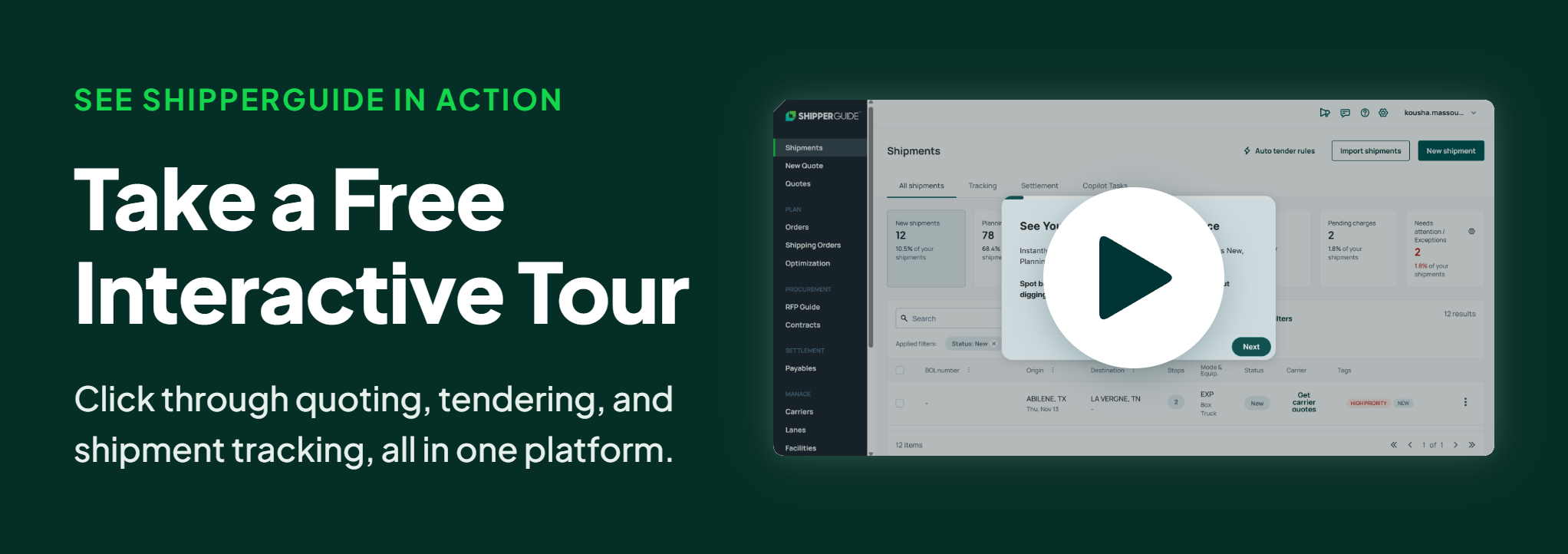
We understand that the idea of an AI companion that utilizes machine learning to act as a digital transportation expert may leave some skeptical. That's why we invite shippers to try a demo of ShipperGuide TMS to get a taste for how our AI-powered data accuracy can simplify data, provide actionable insights, and simplify the process of making smart decisions.

Frequently Asked Questions
What Are the Most Common Data Quality Issues in a TMS?
Inaccurate data, incomplete records, and duplicate entries are the most common issues, but the underlying cause is usually manual re-entry and fragmented workflows between email, spreadsheets, and the TMS itself.
How Does AI Detect and Correct Data Errors in Real Time?
AI detects and corrects data errors in real time through the use of pattern recognition and machine learning. The longer you use an AI-powered TMS, the better it becomes at recognizing anomalies in datasets.
Can AI TMS Tools Improve Accuracy Across Multiple Data Sources?
Yes, AI TMS tools can improve accuracy across multiple data sources, particularly if data entry is standardized so your AI TMS understands how to compare data from different sources.